
Fans of Chelsea and Strasbourg Protest BlueCo Ownership Amid On‑field Struggles

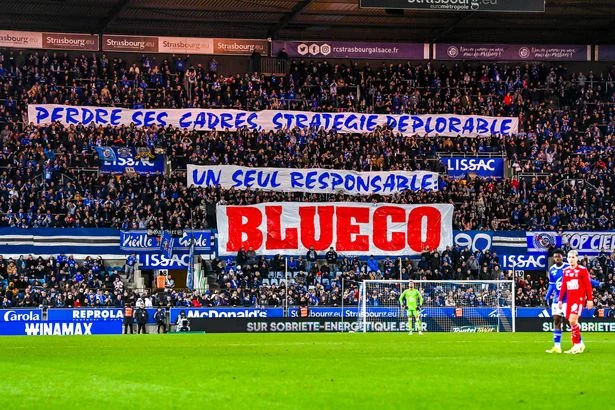
Suara Pecari – 20 April 2026 | On Saturday, hundreds of supporters from Chelsea and RC Strasbourg gathered at Stamford Bridge to stage a coordinated protest against the BlueCo consortium that controls both clubs.
The march began at the Wolfpack Inn, proceeded through the surrounding streets, and culminated in a display of blue smoke, flares and banners outside the stadium.
Protesters accused BlueCo, led by Todd Boehly and Behdad Eghbali, of treating Strasbourg as a subsidiary or “B‑team” for Chelsea.
David Cook, organizer of the demonstration, declared that the unified message was “BlueCo out” and warned of an erosion of club values under the current regime.
Cook added that the march aims to draw the attention of Clearlake Capital investors and highlight the perceived failure of the ownership project both on and off the pitch.
The protest coincided with Chelsea’s Premier League match against Manchester United, a game the Blues lost 1‑0, marking their fourth consecutive goalless defeat.
During the match, chants of “we want our Chelsea back” echoed throughout the stadium, reflecting the growing disconnect between supporters and the boardroom.
Chelsea’s head coach Liam Rosenior, who arrived from Strasbourg earlier this season, faced heightened scrutiny after the defeat and the unrest in the stands.
Rosenior’s appointment followed a controversial swap of personnel between the two BlueCo clubs in January, a move that intensified French ultras’ involvement in the London protest.
Financial analysts warn that Chelsea’s poor league form jeopardizes its chances of qualifying for the Champions League, a key revenue stream for the BlueCo model.
The club’s upcoming FA Cup semi‑final against Leeds United adds pressure, as fans hope a cup run could soften the mounting criticism.
Meanwhile, in France, Strasbourg traveled to Stade de la Meinau to face Rennes in a Ligue 1 encounter that ended in a 0‑3 defeat.
The loss continued Strasbourg’s struggling season, leaving the club well below the safety zone as the campaign approaches its final phase.
Prior to the match, a preview highlighted Strasbourg’s mission to rebound at home, emphasizing the need for a stronger defensive organization and more goal‑scoring options.
The preview also noted the absence of midfielder Valentin Barco and forward Guéla Doué, injuries that weakened the team’s attacking depth.
Rennes entered the match with a fully fit squad and exploited Strasbourg’s defensive lapses to secure three unanswered goals.
Post‑match analysis pointed to Strasbourg’s inability to convert chances and a lack of cohesion in the midfield as primary causes of the defeat.
The heavy loss reinforced concerns among Strasbourg supporters that the club’s identity is being diluted under BlueCo’s dual‑club strategy.
Fans in Strasbourg have echoed the sentiments expressed in London, demanding that the club regain autonomy and stop serving as a feeder for Chelsea.
Local supporter groups organized a small rally outside the club’s headquarters, displaying banners that read “Strasbourg is not a B‑team”.
The dual ownership model, introduced in 2022, promised synergies and financial stability for both clubs, but critics argue that it has delivered the opposite.
BlueCo’s acquisition of Chelsea in 2023 and Strasbourg in 2024 was marketed as a “global football project”, yet the on‑field results have been disappointing for both sides.
In the Premier League, Chelsea sits in the lower half of the table, while Strasbourg hovers near the relegation zone in Ligue 1.
Both clubs share a common challenge: rebuilding squad depth while adhering to UEFA’s financial fair play regulations.
The protest at Stamford Bridge may signal a broader fan backlash across Europe against multinational ownership structures that appear to prioritize profit over tradition.
Sports economists note that such ownership models can create conflicts of interest, especially when player transfers and staff appointments occur between sister clubs.
The January transfer of Liam Rosenior from Strasbourg to Chelsea is cited as a recent example that fueled fan anger on both sides of the Channel.
Despite the turmoil, BlueCo’s representatives have yet to issue a public response to the coordinated protests.
Insider reports suggest that the consortium is reviewing its strategic plan, but details remain confidential.
Observers predict that unless the owners address the supporters’ concerns, further demonstrations could become a regular feature at both clubs.
The upcoming fixtures for Chelsea and Strasbourg will test the resilience of the teams and the patience of their fan bases.
If Chelsea can secure a win in the FA Cup semi‑final, it may alleviate some pressure, but league performance will remain a crucial metric.
For Strasbourg, the next league matches are decisive in the fight to avoid relegation and to reassert the club’s independent identity.
The combined protest highlights a rare moment of cross‑border solidarity among football supporters, underscoring the power of fan activism in modern sport.
As the season progresses, both clubs face a pivotal juncture where sporting results and ownership decisions will shape their future trajectories.






Tinggalkan Balasan
Anda harus masuk untuk berkomentar.